
-
Published
September 3, 2026
-
Category
Thought Leadership -
Share
Facebook LinkedIn X
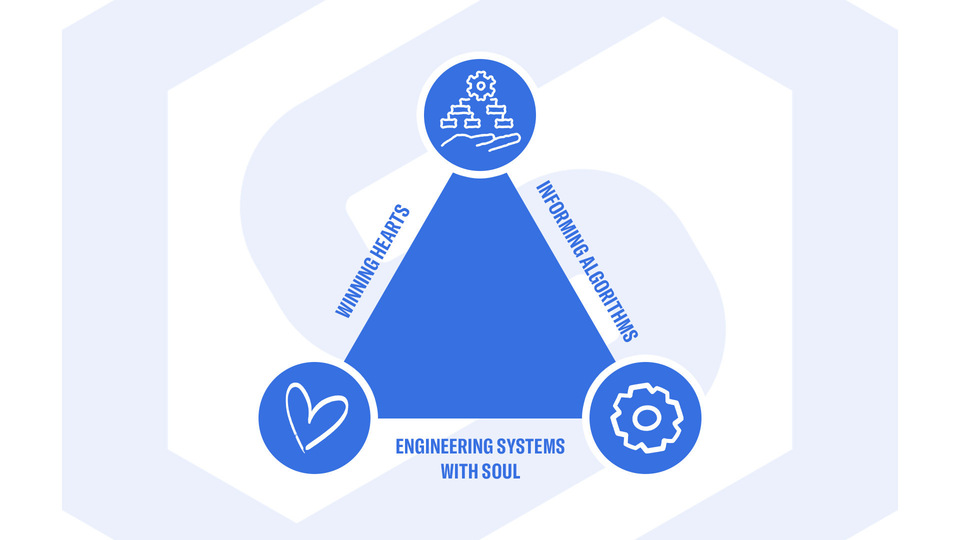
The Love Triangle Every Brand Is in Now
By Lance Porigow, Chief Growth Officer
Originally excerpted on AdAge.
The Shift
The machine is now in the middle.
There is a reason love triangles never disappear. From mythology to prestige drama to reality TV, they endure because they capture emotional tension: divided attention, competing desires, and what happens when someone new enters the relationship.
That is exactly what is happening to brands.
For decades, marketing centered on a relatively simple relationship between a brand and a person. Brands made promises. People decided whether to believe them. Digital made the relationship measurable. Social made it participatory. Performance marketing made it transactional.
Now AI has introduced a third participant.
People no longer just search. They ask. They no longer just browse. They compare. Increasingly, the first interpretation of your brand may not come from your campaign, homepage, or sales team. It may come from a machine.
AI increasingly interprets, summarizes, ranks, and recommends your brand before people ever experience it.
The question is no longer simply whether people love your brand. It is whether machines understand why they should.
That is the strange new tension.
Same triangle. Different relationships.
The most important thing to understand about the new brand love triangle is that humans and machines do not need the same thing from a brand.
People need simplicity.
Human attention is scarce. Brands have seconds, sometimes minutes, to create recognition and meaning. People need a distinctive idea, memorable language, an emotional shortcut, and something that lands quickly.
Machines need depth.
Machines operate differently. Information is fuel. The more useful, specific, structured, contextual, and consistent the brand’s knowledge footprint becomes, the more a machine has to interpret. Simplicity of message should not be confused with scarcity of information.
Both need reasons to believe.
Here humans and machines converge. Neither should rely solely on what a brand says about itself. Both are influenced by authoritative sources and third-party proof: journalism, experts, creators, substantive reviews, communities, customers, and real-world experience.
People need to feel you. Machines need to understand you. Both need reasons to believe you.
The Danger: Artificial Intimacy
As marketers adapt to AI search, answer engines, agents, automation, and increasingly sophisticated personalization, the temptation will be to optimize primarily for machines.
More schema. More prompts. More content. More synthetic personalization.
That is how brands become technically visible and emotionally invisible.
We can all recognize Artificial Intimacy:
- The bot that sounds almost human.
- The personalization that feels almost personal.
- The interaction that knows your name, but not your need.
Technology can simulate attention. It cannot simulate caring.
Machines increasingly interpret brands. People remain the only ones capable of loving them. People still want surprise, recognition, belonging, beauty, proof, and the feeling of being understood.
The opportunity is not to make machines more human. It is to use increasingly intelligent systems to make brands more meaningfully human at every interaction.
The Answer: Systems with Soul
Modern brands must be emotionally meaningful enough for people to care, structurally coherent enough for machines to understand, and commercially effective enough to drive growth.
That requires Systems with Soul.
Soul creates the meaning.
Emotional truth. Cultural relevance. Human point of view. The reason people care in the first place.
The system makes it travel.
Content. Media. Data. Technology. Experience. Reputation. The architecture that helps meaning move consistently across the places people and machines encounter a brand.
Soul without systems creates beautiful moments that disappear.
Systems without soul create efficient marketing nobody remembers.
The goal is not to market to machines instead of humans. It is to build brands strong enough to pass through machines and still reach humans intact.
The Operating System
AI doesn’t see your org chart.
The future cannot be SEO, GEO, AI, PR, media, content, data, creative, CRM, and experience operating independently. AI synthesizes every signal your brand produces. Consumers experience the same signals as one brand, regardless of which department or agency created them.
Modern brands need better P.O.E.M.S. to harmonize every signal.
- Paid to amplify
- Owned to anchor
- Earned to validate
- Machine to interpret
- Shared to prove
When those signals reinforce one another, brands become easier to discover, easier to understand, easier to trust, and ultimately easier to love.
AI Answers
Search used to help people find answers. Now search is the answer.
Traditional SEO has largely asked: Where do we rank?
Generative Engine Optimization introduces a different set of questions: What does AI say about us? Does our brand appear? What does it say? Who appears instead? What sources does it trust? What questions are we not answering?
This shifts discoverability from a page-ranking problem to a brand-understanding problem. A company can rank well in traditional search and still be absent, misunderstood, or poorly represented in an AI answer.
The new question: What do machines believe about your brand?
That means brands need to understand not only their owned content, but the larger evidence ecosystem machines use to form an answer: authoritative editorial coverage, expert commentary, customer reviews, community conversation, structured product information, useful long-form content, and consistent facts across the web.
Example of the triangle: San Francisco Ballet
For Mere Mortals, an immersive San Francisco Ballet performance that reimagined the myth of Pandora as a parallel for AI proliferation, the campaign used AI itself as a creative medium. The team gave ChatGPT detailed context about the ballet’s narrative and production, then asked it for unvarnished reviews.
The idea was not to market to the machine as the audience. It was to influence the machine with richer context, then turn its interpretation back into compelling human-facing content.
The campaign delivered a 142% increase in ticket revenue in one week, a 204% increase in click-through, and more than 10% new ballet attendees.
The machine helped interpret the story. Humans were still the ones we needed to move.
What CMOs Can Do Now
01 Keep it Simple for the Humans.
No change here but just a reminder not to let the complexity of the new world order distract you from keeping your message as simple and emotional as ever for people. We can only process so much information about a brand, especially with all thousands of signals we are exposed to daily. The brand should have a small number of ideas it wants to own and language distinctive enough to survive compression, summarization, and repetition. If people cannot remember it, machines cannot rescue it. One soul. Many signals.
02 Give machines more to understand.
Do not confuse simplicity of message with scarcity of information. Build deeper content around FAQs, expertise, comparisons, use cases, product detail, research, customer questions, and the real decisions people are trying to make. Humans need the shorthand. Machines benefit from the longhand. Simple brand. Rich knowledge.
03 Earn belief. Don’t just claim it.
Invest in journalism, experts, creators, substantive reviews, customers, communities, and culturally credible third parties. First-party claims and advertising still matter, but both people and machines look beyond them for corroboration. Trust is the shared language.
04 Harmonize every signal.
Stop treating PR, media, search, social, content, CRM, and experience as separate stories. They are inputs into one coherent brand. The task is not to make every channel identical, but to make every signal reinforce the same underlying meaning. Consistency compounds. Contradiction confuses.
05 Engineer humanity into the system.
Use data, technology, and AI to understand where someone is, what they need, and what the brand can genuinely do for them in that moment. The goal is not personalization for personalization’s sake. It is relevance that feels useful, timely, and recognizably human. Scale relevance, not Artificial Intimacy.
Engineering Brand Love
The future is not human or machine. It is how brands navigate both.
Brand love is not something we hope emerges after a campaign. It is intentionally built into every signal a brand sends: the story, the content, the media, the experience, the reputation, the search results, the social proof, and the customer journey.
The soul is what makes the brand matter. The system is how that meaning travels.
The next era of marketing will not belong to brands that simply create more content, automate more processes, or bolt AI onto existing strategies. It will belong to brands that know exactly what they stand for and engineer that meaning across every interaction.
Legible to machines without becoming mechanical.
Optimized for algorithms without sounding algorithmic.
Powered by data without losing desire.
Built for performance without losing their pulse.
That is Engineering Brand Love for the age of AI. Not artificial intelligence replacing human emotion. Emotional intelligence engineered into the entire marketing system.
People need to feel you.
Machines need to understand you.
The market needs to trust you.
The brands that win will have the truest soul, carried by the strongest system.
That is how brands get discovered. That is how brands get chosen. That is how brands get remembered. And that is how brands get loved.
RELATED ARTICLES
-
What the Brands We Love Get Right (And What They’re Learning)
- September 23, 2026
- Thought Leadership
-
The Authenticity Era: Winning Through Human Connection
- September 22, 2026
- Thought Leadership
-

Conversational AI Is Creating a New Media Channel. It Will Take More Than One Discipline to Build It.
- August 17, 2026
- Thought Leadership