Our team just got back from SXSW 2026 in Austin: six days of keynotes, packed sessions, great tacos, and a lot of impromptu conversations that turned out to be meaningful and filled with potential.
Every year SXSW surfaces what’s actually shifting in marketing and technology before it becomes common knowledge. This year, the signal was unusually clear. The biggest highlights for us:
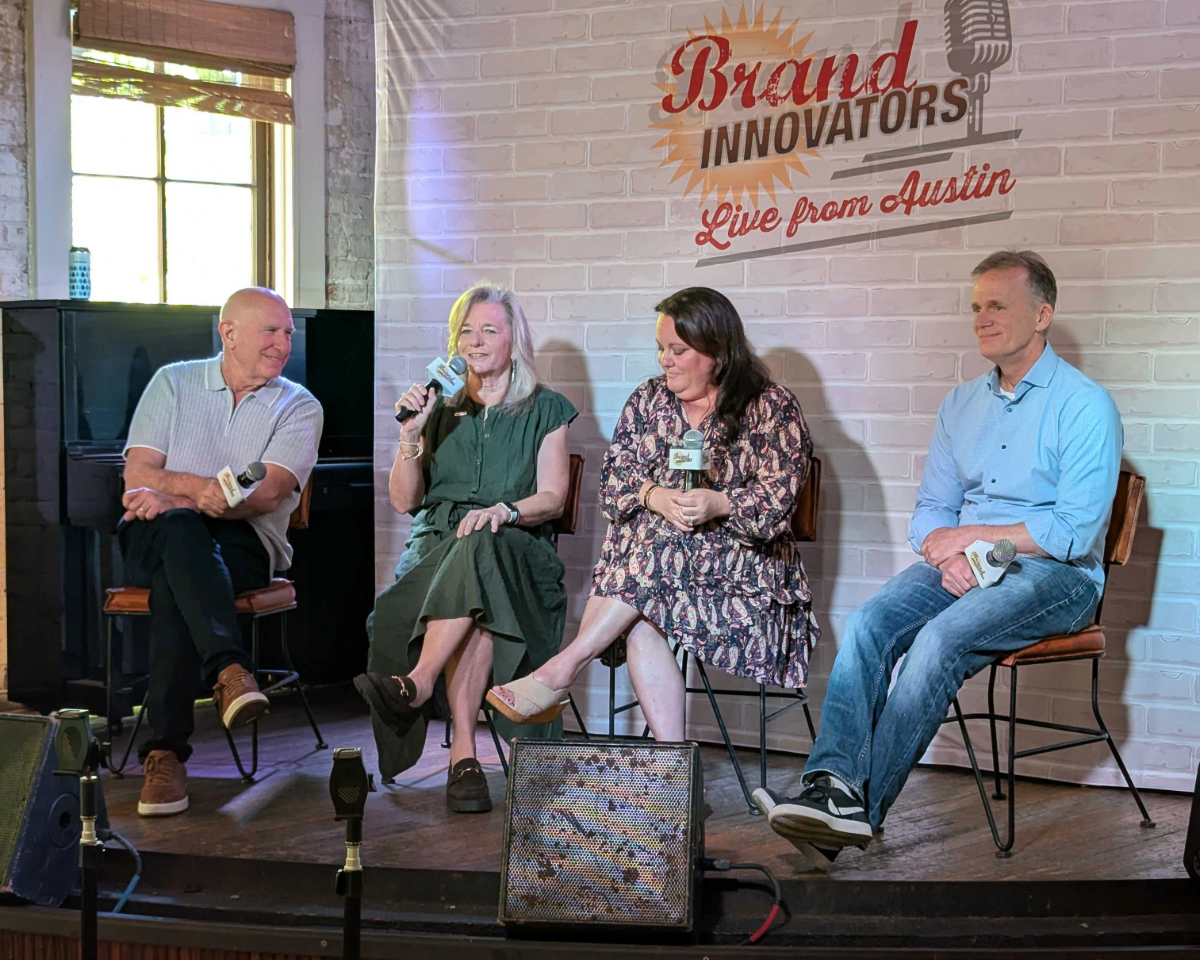
- Our CEO, Rick Milenthal, was on a panel to discuss what it takes to move from awareness to real consumer behavior change in the electric vehicle industry, along with our client Veloz, NBCUniversal, and iHeartMedia.
- Speaking of iHeartMedia, we sat alongside some of the world’s biggest podcasters at the iHeartPodcasts dinner to celebrate the launch of the TikTok Podcasts Network, a multiplatform partnership that is bringing dozens of top TikTok creators into iHeart’s ecosystem. Podcasting just turned it up to eleven.
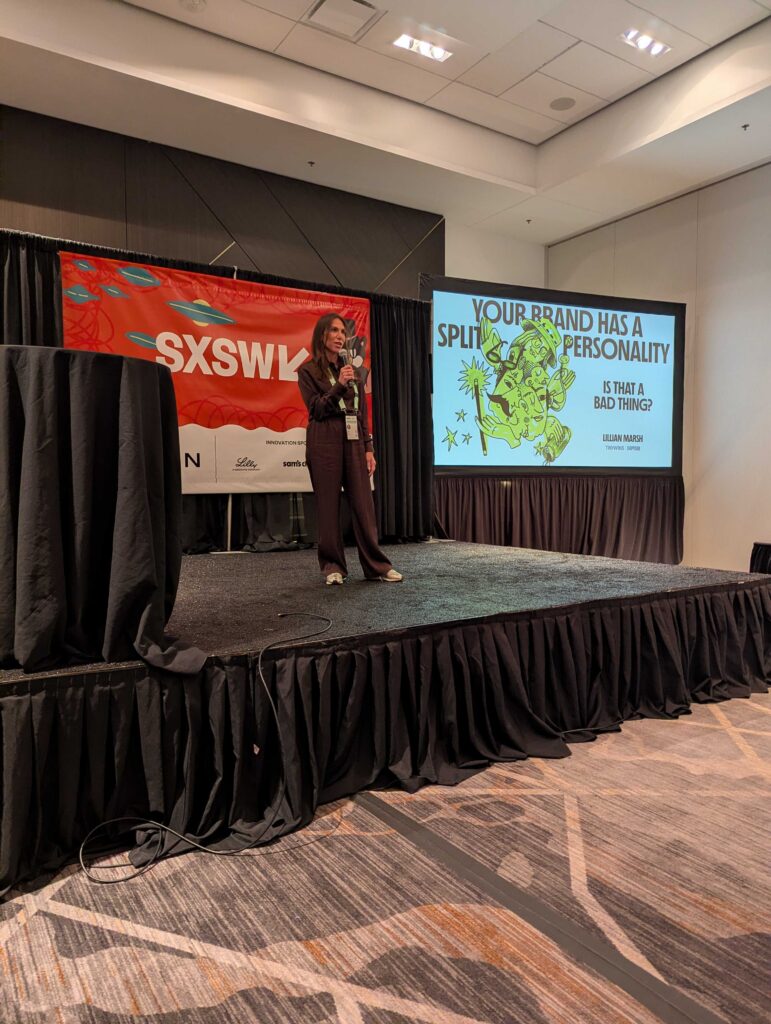
- OurChief Branding Officer and Co-Founder of TinyWins, Lillian Marsh, crushed her SXSW presentation on “Your Brand Has Multiple Personalities. Is That A Problem?”. It was the most packed session we sat in all week.
- Veloz showed up big elsewhere, too, with the Electric For All Recharge Café refueling guests all weekend at the iHeartPodcasts Hotels.
If you couldn’t attend or couldn’t see everything, we’ve got you. Here’s what you need to know about what was discussed at SXSW 2026, and what will matter most for your business right now:
Humanity Is Your Big Differentiator
This was the undercurrent of almost every session we attended. As AI floods the content l
andscape, the premium on genuine human perspective, emotional truth, and
creative risk has never been higher. A session on consumer insights made the point sharply: AI is very good at pattern recognition and surfacing observations, but a real insight, the kind that makes a creative team’s head snap up, requires tension, specificity, and human judgment that no model can replicate yet.
The challenger brands outperforming legacy players aren’t doing it with bigger budgets, they’re doing it with more authentic voices, real consumer empathy, and a willingness to make things that feel unmistakably human. Younger consumers especially have sharp instincts for the difference between genuine conviction and corporate performance. The brands they trust have a real point of view. The ones they ignore don’t.
Brand Worlds Beat Brand Campaigns
Some of the most compelling brand work discussed at SXSW — from Dove’s 20-year Real Beauty platform to Hellmann’s consistent Super Bowl presence — shared one thing in common: a point of view that didn’t change, even as the executions did. The Unilever CMO on stage put it simply: protect the meaning, reinvent the expression.
Hellmann’s is a useful case study in what this looks like at scale — showing up for BookTok fans, Super Bowl viewers, and NBA audiences all in the same year, in very different ways, because they’ve locked in where food meets culture as their territory and they don’t deviate from it. Dove’s story is even longer — 20 years of the same belief, endlessly reinvented, now the world’s most inclusive brand as voted by women.
The brands building long-term equity aren’t running campaigns, they’re building worlds — consistent universes of meaning that communities want to participate in. If your brand doesn’t have a genuine belief at its center, that’s the most important thing to solve before your next brief.
AI Is Now Infrastructure, Not Innovation
Nobody at SXSW was debating whether AI would change things; they were debating how fast their organizations could keep up. Practical AI is reshaping creative production, content workflows, and consumer research at every level. Creative departments are being restructured entirely around AI-augmented workflows, with creative directors increasingly acting as quality gatekeepers and prompt engineers rather than pure ideators.
Adobe’s Hannah Elsakr made the case that creators who use AI tools actually produce more diverse outputs and explore more creative directions, as long as they retain editorial control.
The brands and agencies pulling ahead aren’t treating AI as a cost-cutting tool. They’re using it to expand capability: doing more, testing faster, and building things that simply weren’t possible before. The gap between teams using AI strategically and those using it reactively is widening fast. The question worth asking: which side is your team on?
Search Is Being Rebuilt From the Ground Up
If your brand depends on Google traffic, it’s time for a real conversation. AI-powered answer engines are intercepting queries before users ever click through to a website, and the behavior is accelerating. Data shared at SXSW showed that more than 40% of users are already relying on AI for a significant portion of their search activity, with Gen Z leading the shift toward TikTok, Amazon, and AI tools for discovery.
A panel with executives from Mastercard and Mars made the stakes visceral: if your products aren’t readable by large language models (properly tagged, structured, and present in credible third-party sources) AI agents simply won’t recommend you. One Mars marketer said their team calculated they needed to increase content development by 250% just to stay visible in AI-driven discovery.
Traditional SEO isn’t going away, but it’s no longer enough on its own. Answer Engine Optimization (AEO) and Generative Engine Optimization (GEO) aren’t buzzwords — they’re becoming table stakes.
Entertain or Grow Slowly
Research presented on stage showed that of the top 30 most entertaining brands in the US, two-thirds had double-digit revenue growth last year. Entertainment isn’t a creative preference, it’s a growth lever. And it doesn’t just mean comedy: Squarespace ran a cinematic Super Bowl spot directed by Yorgos Lanthimos, shot on 35mm film, with a custom costume designer and a real set built on a London soundstage; and then released the behind-the-scenes story as a second piece of content that earned as much earned media as the ad itself. Dr. Squatch built a brand by embedding inside the stand-up comedy ecosystem, not just running funny ads, but partnered with comedians the way Red Bull partners with action sports athletes. The brand became a natural part of the culture rather than an interruption.
One research finding that stuck with us: comedy actually scored lowest among genres people want to see less of from brands. It’s not because people want to laugh less, but because most brands do comedy badly, defaulting to lowest-common-denominator humor that pleases no one. The brands doing it well commit fully to a specific tone for a specific audience. The question isn’t whether to entertain. It’s whether your creative is actually earning attention or just buying it.
The Creator Economy Is Growing Up
The transactional influencer model: one-off sponsored posts, CPM metrics, usage rights negotiated after the fact, came up repeatedly as a diminishing return. The sessions pointed toward a fundamentally different model: long-term creative partnerships where creators are treated as co-authors of the brand, not a media channel to be purchased.
Creators aren’t just distribution, they’re building the worlds brands want to live in. They need to be inside the strategy from the beginning, not handed a brief at the end. Disney CMO Tasia Filippatos put it from the brand side: the goal isn’t creators making content about your brand. It’s creators making content that’s unmistakably them that happens to open a door to your world.
The practical shift looks like minimum 6-to-12-month commitments with genuine creative co-development rather than usage rights. Revenue sharing and equity arrangements are becoming more common at the top end. And the measurement conversation is evolving away from reach and impressions, toward community growth, brand sentiment, and cultural credibility. An impression that doesn’t change how someone feels about your brand isn’t worth what it used to be.
Synthetic Audiences and the Future of Consumer Research
This one is early but accelerating faster than most marketers realize. Multiple sessions explored the emergence of AI-powered synthetic consumer populations: thousands of AI personas built from real consumer data that brands can talk to in real time, in any direction, without waiting months for traditional research.
Planet Fitness was the most developed live case study on the floor. Their VP of Member Experience described using AI-powered consumer populations, built from their actual 21-million-member base, to test messaging, campaign ideas, and future gym concepts at a scale and speed that traditional focus groups simply can’t match. Anyone in the organization, not just the insights team, can have a conversation with a representative member population and get directional feedback in hours instead of weeks.
The nuance worth holding onto: synthetic audiences are genuinely powerful for qualitative exploration and rapid idea testing, but they don’t replace real consumer validation; they compress the time between hypothesis and human confirmation. One executive on stage predicted that synthetic customers will be standard inside every marketing department within 24 months. The brands that have already started building this muscle will have a meaningful head start when that moment arrives.
AI Agents Are About to Rewrite Commerce
This one goes further downstream than the search conversation, all the way into actual purchasing behavior. A panel featuring executives from Mastercard, Mars, and Bain & Company was one of the richest sessions of the conference, and the takeaway was stark: we are moving from a world where humans discover and purchase, to one where AI agents do both on their behalf.
The infrastructure for this is being built right now. Mastercard’s Agent Pay, verifiable intent frameworks, and trust authentication systems are live in early markets. The panel predicted meaningful agent-driven transactions within 12 to 18 months, with full adoption accelerating quickly once the trust and security infrastructure is standardized.
The implication for brands is profound and underappreciated. If an AI agent is making purchasing decisions for a consumer, your brand needs to be discoverable, trustworthy, and recommendable to a machine, not just to a person. Product data needs to be structured. Content needs to be conversational. Third-party credibility (reviews, editorial mentions, structured product data) becomes more important than owned channel presence. The Mars team put it plainly: they need to train the machines to recommend their brands the same way they’ve spent decades training humans. One speaker described it as the biggest shift in how brands need to think about marketing since the move to mobile.
Boring Categories Are a Creative Advantage
Two of the richest sessions at SXSW were dedicated to brands in low-excitement, low-expectation categories: B2B tech, soap, olive oil, domains; that are outperforming their categories precisely because they’re not acting like they belong in them. The argument: low category expectations are a competitive advantage, not a constraint.
Squarespace sells domains and website builders but runs Super Bowl spots alongside Nike and Budweiser. Their brand director explained that the unremarkable category is actually where the permission comes from: nobody expects anything from a website platform, so every piece of interesting creative lands harder than it would from a brand in an inherently exciting space. The low bar creates the opening.
Twilio, which makes the invisible infrastructure behind SMS messages and verification codes, is building brand equity in D&D and RPG subcultures because that’s where their developer audience actually lives. It’s not where their audience uses Twilio, but who they are when they’re not thinking about Twilio at all. The research process described (mapping the fandoms of your audience beyond your product category) was the sharpest insight from both sessions: stop trying to understand how your customers interact with your product. Start understanding who they are when they’re not your customer at all.
The challenger CPG brands made the same point from the consumer side. Liquid Death, Graza, Goodles, Coconut Cult. None of them can outspend the incumbents on paid media. None of them can out-distribute them. So they out-human them. The creative comes from a genuine point of view, built in-house by small teams with diverse backgrounds, iterated quickly, and put out without the need to committee it to death. As one Liquid Death executive put it: the risk isn’t doing something unexpected. The real risk is being ignored.